Hey there! I’m an anchor bolt supplier, and I often get asked this burning question: "What is the maximum load an anchor bolt can bear?" It’s a crucial query, especially for those in the construction and engineering fields. So, let’s dive right in and break it down. Anchor Bolt

First off, it’s important to understand that there’s no one – size – fits – all answer to this question. The maximum load an anchor bolt can bear depends on a bunch of factors. One of the most significant ones is the type of anchor bolt.
We’ve got different kinds of anchor bolts, like expansion anchor bolts, chemical anchor bolts, and wedge anchor bolts. Each type has its own unique characteristics and load – bearing capabilities.
Expansion anchor bolts work by expanding inside a pre – drilled hole in the base material, usually concrete or masonry. When you tighten the nut on the bolt, the expansion sleeve at the end of the bolt expands, creating friction against the walls of the hole. This friction is what holds the bolt in place and allows it to bear a load. But the maximum load it can handle varies based on the size of the bolt, the quality of the expansion mechanism, and the strength of the base material. For example, a small – sized expansion anchor bolt in a low – strength concrete might only be able to bear a few hundred pounds, while a large – diameter one in high – strength concrete could handle several thousand pounds.
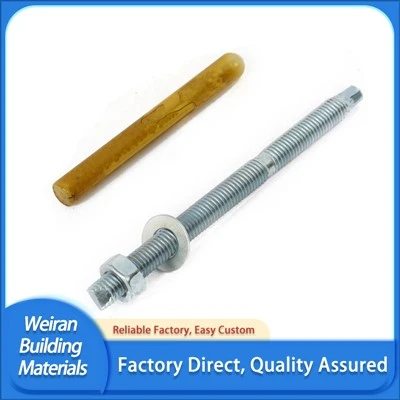
Chemical anchor bolts, on the other hand, rely on a chemical adhesive to bond the bolt to the base material. The chemical is injected into the pre – drilled hole, and then the bolt is inserted. As the chemical cures, it forms a strong bond that can support substantial loads. Chemical anchor bolts are great for applications where high loads are required, especially in situations where the base material might be cracked or have other imperfections. The maximum load for a chemical anchor bolt is determined by the type of adhesive used, the depth of the embedment, and the surface condition of the bolt. A well – installed chemical anchor bolt in a good – quality base material can withstand extremely high loads, sometimes even tens of thousands of pounds.
Wedge anchor bolts are another popular type. These bolts have a wedge – shaped end that expands when the nut is tightened. The wedge digs into the base material, providing a secure hold. The load – bearing capacity of wedge anchor bolts depends on the size of the bolt, the embedment depth, and the strength of the base material. They’re often used in heavy – duty applications, like attaching structural steel to concrete. A large wedge anchor bolt properly installed in high – strength concrete can bear a very large load, but if the base material is weak or the installation is incorrect, the load – bearing capacity will be significantly reduced.
The base material itself plays a huge role in determining the maximum load an anchor bolt can bear. Concrete is one of the most common base materials for anchor bolts. The strength of concrete is measured in pounds per square inch (psi). Higher – strength concrete, say 5000 psi or more, can support much higher loads than lower – strength concrete, like 2500 psi. Masonry, such as brick or block, also has different load – bearing capabilities depending on its type and quality. For instance, a solid brick wall will generally provide better support for an anchor bolt than a hollow – core block wall.
The installation process is also super important. If an anchor bolt isn’t installed correctly, its load – bearing capacity can be seriously compromised. For expansion anchor bolts, the hole must be drilled to the correct diameter and depth. If the hole is too large, the expansion mechanism won’t work properly, and the bolt won’t hold. For chemical anchor bolts, the hole must be clean and dry before the adhesive is injected, and the bolt must be inserted at the right speed and depth. Any mistakes in the installation can lead to a weak bond and a lower maximum load.
Another factor to consider is the type of load. There are different types of loads, such as static loads and dynamic loads. Static loads are those that don’t change over time, like the weight of a building structure. Dynamic loads, on the other hand, are those that change, like vibrations from machinery or wind forces. Anchor bolts need to be designed to handle both types of loads. A bolt that can handle a large static load might not be able to withstand a dynamic load of the same magnitude.
Now, let’s talk about how we, as an anchor bolt supplier, can help you figure out the maximum load for your specific application. We work with a team of engineers who are experts in anchor bolt design and installation. When you come to us, we’ll first ask you a bunch of questions about your project, like the type of base material, the type of load, and the environment where the anchor bolts will be used.
Based on this information, our engineers will use specialized software and industry – standard formulas to calculate the maximum load that the anchor bolts can bear. We’ll also take into account any safety factors. Safety factors are used to ensure that the anchor bolts can handle loads well above what they’re expected to experience in normal use. This gives you an extra margin of safety and peace of mind.
We also offer a wide range of anchor bolts in different sizes, types, and materials. Whether you need a small expansion anchor bolt for a light – duty application or a large chemical anchor bolt for a heavy – duty project, we’ve got you covered. Our products are made from high – quality materials and are tested to meet or exceed industry standards.
If you’re in the middle of a project and need to know the maximum load an anchor bolt can bear, don’t hesitate to reach out to us. We’re here to help you make the right choice and ensure that your project is safe and successful. Whether you’re a contractor, an engineer, or a DIY enthusiast, we’ve got the knowledge and the products to meet your needs.
In conclusion, determining the maximum load an anchor bolt can bear is a complex process that involves considering many factors, including the type of anchor bolt, the base material, the installation process, and the type of load. But with the right knowledge and the right products, you can ensure that your anchor bolts will perform as expected. If you’re interested in purchasing anchor bolts or have any questions about their load – bearing capabilities, just get in touch with us. We’re always happy to have a chat and help you find the best solution for your project.
Anchor Bolt References
- "Design of Anchor Bolts in Concrete Structures" by American Concrete Institute
- "Handbook of Anchor Installation" by International Masonry Institute
- "Anchor Bolt Engineering Principles" by Structural Engineers Association of America
Shandong Weiran Building Materials Co., Ltd.
Shandong Weiran Building Materials Co., Ltd. is one of the most experienced anchor bolt manufacturers and suppliers in China, also supports customized service with low price. Welcome to buy bulk high quality anchor bolt in stock here from our factory. Contact us for quotation.
Address: No.1, Street-front Shop, Jia 19, No.137 East Xingyuan Road, Zhangdian District, Zibo City, Shandong Province, China
E-mail: qinjuan@sdwrjc.com
WebSite: https://www.sdwrjc.com/
