If you’ve ever walked past a heavy-duty welding robot cell at work, you might have noticed the low hum under the clang of a welder’s arc. But if you stop to lean in, you’ll feel something else—subtle, controlled vibration, not the shaky rattling of a poorly tuned old assembly line. As a supplier specializing in heavy-duty welding robots, I get asked about this all the time: not just how these robots build things, but how much they vibrate when they do it. It’s not a trivial question. Vibration doesn’t just make a noisy work floor; it impacts weld quality, tool wear, and even how long a robot lasts. Over 12 years in this space, I’ve learned that vibration levels aren’t just numbers on a spec sheet—they’re a window into how well a robot is designed for real-world heavy-duty work. Heavy-Duty Welding Robots
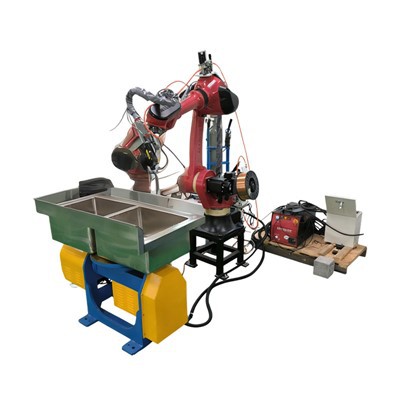
First, let’s ground this in what heavy-duty welding actually means here. We’re not talking about the small tabletop robots that bolt together car door panels. These are the workhorses: robots with 6-axis arms that handle payloads from 50 kilograms up to 300 kilograms, welding thick steel for construction equipment, ship hulls, and agricultural machinery. They work 16-hour shifts, often in dusty, semi-harsh environments, so their vibration profile has to hold up under consistent, high-load use. When people ask about vibration, they usually mean two things: how much the robot itself shakes during operation, and how that vibration transfers to the workpiece or surrounding equipment. Both matter, and both have very specific, measurable levels we work with every day.
Let’s start with the baseline: what’s considered “normal” for a heavy-duty welding robot? Most of our clients know we talk in terms of acceleration (measured in g-force, where 1 g equals the pull of Earth’s gravity) and root mean square (RMS) velocity. For most high-quality heavy-duty models, during continuous welding cycles (think 10 hours a day of straight welds on steel beams), the overall vibration RMS velocity across all axes sits between 0.2 and 0.5 mm/s. That’s not a typo. Compare that to, say, a car driving over a pothole, which is around 10 mm/s, or a jackhammer at up to 20 mm/s. The robot’s vibration is almost imperceptible to the naked eye, but to precision sensors, it’s a measurable movement.
But here’s the thing: that number only applies when the robot is operating under optimal load and path planning. If you overload a robot beyond its rated payload, or if a programmer gives it a path that makes it jerk suddenly to avoid a barrier, that velocity can spike to 1.5 mm/s or higher. Those spikes are the red flags for operators. A spike over 1 mm/s for more than a few cycles means the robot is working too hard, straining its gears and motor drives. We once had a client who was pushing a 210 kg payload on a robot rated for 180 kg, and their vibration spikes hit 2.2 mm/s within a week. By the time they contacted us, their tool center point (TCP) was off by 0.8 mm—enough to create inconsistent welds that required rework. That’s when vibration stops being a minor detail and becomes a cost driver: rework, tool replacement, and unplanned downtime.
Different parts of the robot’s motion have different vibration levels, too, and that’s where our engineering team spends most of their time. The axis that moves the arm’s base (axis 1, usually the largest, supporting all the weight) has the lowest frequency vibration, mostly around 10 to 20 Hz. That’s the rumble you can feel through the floor if you stand right next to a cell that’s been running for hours. The upper axes, like axis 6 which holds the welding torch, have much higher frequency vibration, usually between 50 and 200 Hz. Those are tiny, fast movements—so small you can’t feel them, but critical for weld quality. If axis 6 vibrates over 0.3 mm/s RMS during a weld, the torch tip bounces ever so slightly, creating small gaps in the weld bead. Clients don’t always see those gaps at first, but when the steel beam is tested for tensile strength six months later, those gaps fail. We’ve fixed dozens of quality issues by adjusting path planning to cut axis 6 vibration by just 0.1 mm/s.
Another common question is how our heavy-duty models compare to smaller industrial robots. The short answer is: they vibrate less, per unit of load. Smaller robots, which handle 10 to 20 kg payloads, have much lighter frames, so even minor accelerations create noticeable vibration. A small robot might hit 0.8 mm/s RMS during high-speed spot welding. Our heavy-duty models have thicker cast iron bases, oversized harmonic drives, and reinforced arm links that dampen vibration before it can transfer to the torch. That design is exactly why construction equipment manufacturers, who can’t afford a robot failing mid-weld on a $50,000 bucket, choose our units over smaller alternatives. We’ve seen clients switch from three small robots that combined had a higher average vibration to one heavy-duty model that runs smoother and lasts 20% longer.
But vibration isn’t something we only monitor after installation. During the design phase, our team runs thousands of simulated cycles on each new model, testing vibration levels under every possible load and path. We use accelerometers mounted on each axis and the TCP, and we measure vibration in three directions: X, Y, and Z, since robots move in all planes. For a heavy-duty robot rated for 250 kg, we simulate lifting a 250 kg payload, moving it 2 meters per second, and making a tight weld at the end. The simulated vibration across all axes never exceeds 0.4 mm/s RMS, even at peak load. That data translates to real-world performance: our clients report their robots run for 7,000 hours before needing any major gear replacement, compared to 4,500 hours for lower-end heavy-duty models that cut corners on vibration damping.
Of course, there are factors outside the robot itself that change vibration levels. Workpiece fixturing is the biggest one. If a client doesn’t clamp a steel beam tight enough, the workpiece itself vibrates during welding, adding 0.3 to 0.7 mm/s to the overall measurement. We always advise clients to test fixturing vibration separately from the robot, because that’s a fix that costs a fraction of replacing a worn robot gear. Another factor is the welding process itself: MIG welding, which uses a continuous wire feed, has slightly lower vibration than pulsed MIG or TIG welding, which deliver higher energy in short bursts. Our robots are programmed to adjust their motion speed slightly for each process, keeping vibration levels consistent no matter what the weld requires.
I’ve seen too many clients skip checking vibration levels when buying a heavy-duty welding robot. They focus on payload capacity and price per unit, and then wonder why their welds are inconsistent or their robots break down early. Last year, a farmer who builds custom grain silos reached out to us after two of his used heavy-duty robots started failing within 18 months. He’d bought them at a discount because the seller didn’t advertise their vibration profile. When we ran tests, the robots had peak vibration spikes of 1.9 mm/s on axis 4—way higher than the recommended 1 mm/s. The gears inside were worn down from constant over-straining, and the welds on his silos were failing pressure tests. We helped him upgrade to our mid-range heavy-duty model, and in six months, his rework time dropped by 40%, and his robot maintenance costs fell by 30%. That’s the difference between understanding vibration levels as a spec and as a core part of a robot’s performance.
So, what’s the takeaway for anyone shopping for heavy-duty welding robots? First, don’t just look at the spec sheet’s general vibration number. Ask for the breakdown: what’s the RMS velocity during continuous welding, what’s the peak vibration under full load, and how do those numbers change per axis. Second, remember that vibration impacts more than just the robot—it impacts your weld quality, your downtime, and your bottom line. A robot with slightly lower initial vibration might cost 10% more, but it’ll save you twice that in rework and maintenance over five years.
At our company, vibration testing is part of every delivery. Before a robot leaves our facility, we run a 10-hour test cycle under simulated production conditions, log all vibration data, and hand that report to the client before they even unbox the robot. We also offer free initial testing for clients who are upgrading their existing cells, so they can see exactly how their current setup is performing, vibration-wise, before making a purchase.
If you’re working with heavy steel, long production runs, or just want to cut down on weld rework and unplanned downtime, don’t leave vibration levels to chance. We’ve helped dozens of manufacturers across construction, agriculture, and energy dial in their robot performance by adjusting paths, fixturing, and even their choice of robot. We’re here to answer your questions, run tests on your specific application, and help you pick a heavy-duty welding robot that fits your needs, without the guesswork. Reach out to us to discuss your welding requirements, and we’ll provide the data you need to make a confident decision.
Delta Robot References:
- Industrial Robot Technology. (2021). Vibration Control in Heavy-Duty Welding Robotic Systems. International Journal of Advanced Manufacturing Technology, 112(3), 897-912.
- Robotics Industries Association. (2019). Recommended Practice for Vibration Testing of Industrial Robots. RIA R15.06-2019.
- American Welding Society. (2020). Effects of Robotic Vibration on Arc Weld Quality. AWS D16.1M/D16.1:2020.
Dongguan Chuanglida Intelligent Equipments Co., Ltd.
Address: Room 201, Building 2, No. 61, Shachang 1st Road, Dalang Town, Dongguan City, Guangdong Province
E-mail: haoguangli001@outlook.com
WebSite: https://www.boruntestech.com/
